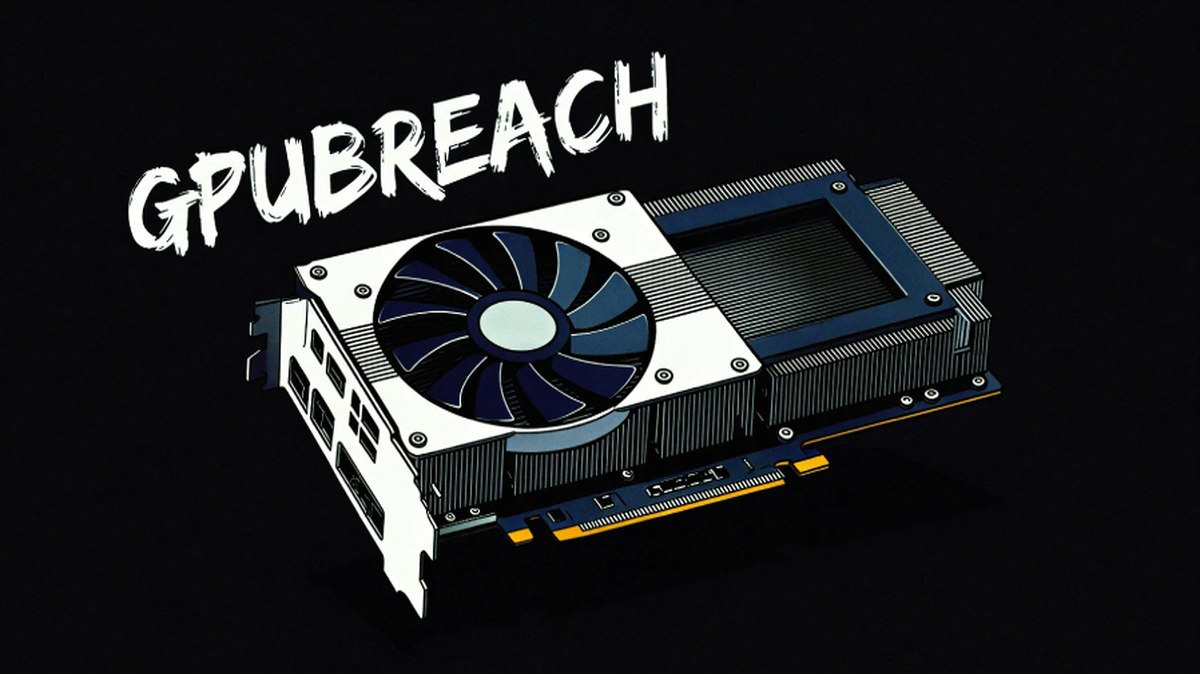
A groundbreaking academic study has revealed a new class of hardware-level vulnerabilities affecting modern Graphics Processing Units (GPUs), posing a severe threat to system security. Dubbed "GPUBreach," alongside related attack vectors "GDDRHammer" and "GeForge," this research demonstrates that high-performance GPUs, particularly those utilizing GDDR6 memory, are susceptible to sophisticated RowHammer-style attacks. These attacks can induce bit-flips in the GPU's memory, a flaw that malicious actors can weaponize to escalate privileges on the central processing unit (CPU) and, in the worst-case scenario, seize complete control of the host system. This represents a significant escalation from prior GPU-focused research, moving beyond proof-of-concept demonstrations to illustrate a tangible path to full system compromise.
The core of the vulnerability lies in the physical design of modern DRAM, specifically the high-density GDDR6 memory prevalent in contemporary graphics cards. The RowHammer effect, a well-documented phenomenon in CPU security, occurs when repeatedly accessing (or "hammering") a specific row of memory cells causes electrical interference that flips bits in adjacent, unaccessed rows. The GPUBreach research proves this same fundamental weakness is exploitable in GPU memory. By crafting specific computational workloads that aggressively target memory rows, an attacker—even from an unprivileged user-space application—can induce predictable bit-flips in the GPU's GDDR6. These corrupted memory values can then be leveraged to manipulate GPU operations and, critically, breach the security boundary between the GPU and the host CPU.
The implications of GPUBreach are profound for both consumer and enterprise environments. A successful exploit could allow malware, initially confined to a low-privilege environment like a web browser or a standard user application leveraging GPU compute (e.g., via WebGL or CUDA), to break out and gain elevated kernel-level privileges on the host operating system. This cross-device privilege escalation from GPU to CPU is a novel and dangerous attack vector. It undermines fundamental security assumptions about hardware isolation, suggesting that a compromise of a peripheral processing unit can serve as a springboard to total system control. Systems relying on GPUs for critical workloads, including cloud computing instances, scientific research clusters, and high-performance workstations, are all potentially at risk.
Mitigating the GPUBreach family of vulnerabilities requires a multi-layered approach, as purely software patches may be insufficient against a hardware-level flaw. GPU manufacturers like NVIDIA, AMD, and Intel will need to investigate and potentially implement physical or firmware-level mitigations in future memory controller designs, such as enhanced error-correcting code (ECC) or improved memory access patterns. In the interim, system administrators and security-conscious users should prioritize keeping GPU drivers and system firmware updated, as vendors may release microcode or driver-level workarounds. Furthermore, adopting a security posture that minimizes the attack surface by restricting untrusted code from accessing high-performance GPU functions is advisable. This research underscores the evolving landscape of hardware security, where threats increasingly emerge from the complex interplay between system components once considered peripherally secure.