The modern phishing threat has evolved beyond simple deception. The most perilous campaigns today are engineered not merely to fool an employee but to strategically exhaust the security analysts tasked with stopping them. When a phishing investigation that should take five minutes balloons into a 12-hour ordeal due to overwhelming volume, the outcome shifts decisively from a contained incident to a full-scale breach. This evolution marks a critical turning point, where the Security Operations Center (SOC) itself becomes the primary attack surface.
For years, cybersecurity strategy has concentrated on the "front door" of phishing defense: employee security awareness training, advanced email gateways to filter known threats, and internal reporting programs that encourage users to flag suspicious messages. However, significantly less attention has been paid to the back-end investigative process that follows a report. Attackers operating at scale have identified this operational gap. They now design campaigns with the explicit dual objective of compromising end-targets while simultaneously overwhelming the SOC analysts responsible for investigation and response. Alert fatigue, therefore, is no longer just an operational inefficiency; it is a weaponized vulnerability that adversaries actively exploit.
This paradigm shift fundamentally changes how organizations must conceptualize phishing defense. The critical vulnerability is no longer solely the employee who might click a malicious link. It is equally the overburdened analyst who cannot keep pace with an intentionally inflated alert queue. When investigations stretch from minutes to hours due to deliberate congestion, the window for an attacker to move laterally, escalate privileges, and exfiltrate data widens exponentially. Phishing can no longer be treated as a series of isolated, independent threats—one message, one victim, one ticket. Sophisticated attackers think in terms of systemic weaknesses. A SOC, with its finite human and technological capacity, is a system with predictable stress points and failure modes.
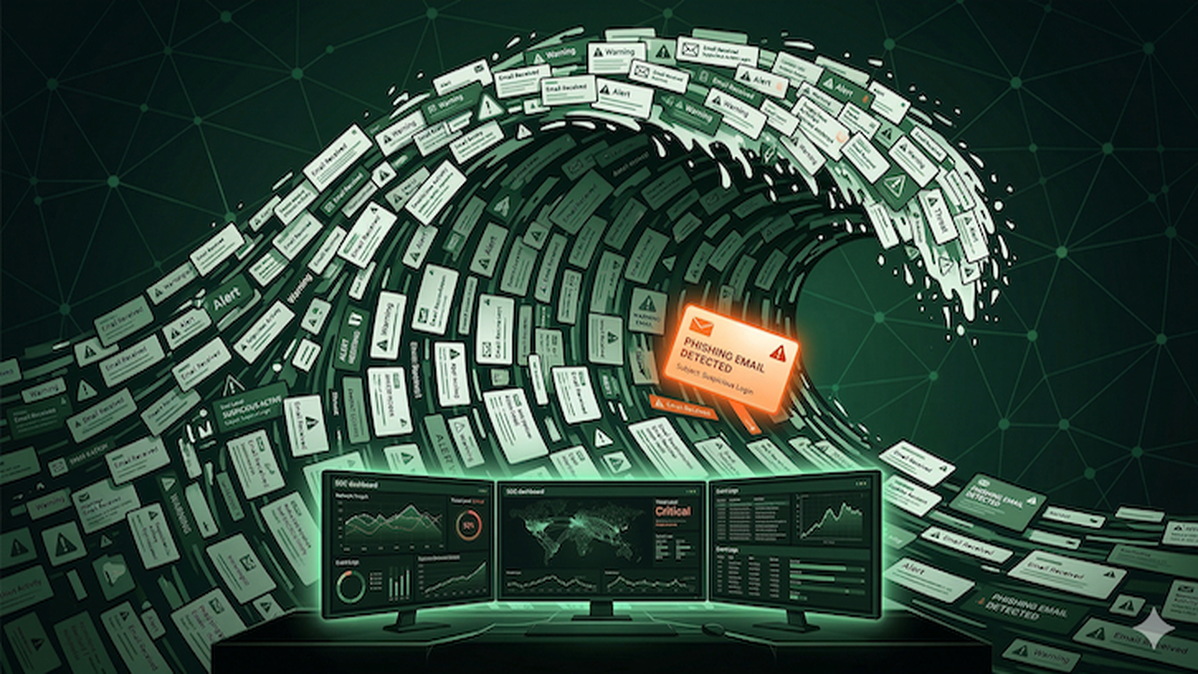
Consider a coordinated campaign against a large enterprise. The attacker dispatches tens of thousands of messages. The majority are low-sophistication, generic lures that email gateways or vigilant employees will likely identify and report. This deliberate "noise" floods the SOC ticketing system, generating a tsunami of alerts that analysts must triage. As they work through a queue that grows faster than it can be cleared, their capacity for deep analysis diminishes. Concealed within this high-volume noise are a handful of meticulously crafted, highly targeted spear-phishing messages. These high-priority threats, aimed at executives or system administrators, are now at grave risk of being lost in the shuffle or investigated with rushed, superficial scrutiny due to analyst exhaustion. The attacker's strategy succeeds by weaponizing the SOC's own workflow, turning its defensive processes into the very mechanism that enables a breach.
To counter this advanced threat, organizations must evolve their defense-in-depth strategy. Investing in Security Orchestration, Automation, and Response (SOAR) platforms is crucial to automate the triage and initial investigation of high-volume, low-risk alerts, freeing analysts for complex threats. Furthermore, threat intelligence must be integrated to contextualize alerts and identify coordinated campaigns rather than isolated emails. Ultimately, resilience requires measuring and managing SOC capacity as a critical security metric, ensuring that the human element of cybersecurity is not the weakest link that adversaries can systematically target and fatigue into failure.